
The Psychology of Group Delusion: Plato's Timeless Warning to the Modern World
Ever found yourself wondering why so many people seem to buy into the same obvious bull crap all at once? Or why intelligent folks, when they gather in groups end up making decisions that look utterly bonkers in hindsight? The Psychology of Group Delusion: Plato's Timeless Warning to us.
11/6/20256 min read
Ever found yourself wondering why so many people seem to buy into the same obvious bull crap all at once, like everyone suddenly queuing up for the latest gadget fad just because the crowd's buzzing about it? Or why intelligent folks, when they gather in groups, be it at a family do or a heated online debate, end up making decisions that look utterly bonkers in hindsight? This pattern's been repeating through history with the predictability of a British summer washout, letting us spot when societies ditch harsh realities for cosy fibs.
Right now, as you're reading this over your morning brew, billions worldwide (including plenty of us in the UK) are actively picking deception over truth. They're not daft, not clueless, and not just victims of spin. No, they're making a calculated, often subconscious, choice to embrace lies because the truth threatens something far more precious… their sense of belonging, their identity, and their whole understanding of who they are in this chaotic world.
This isn't a fresh glitch from social media echo chambers or political divides like Brexit. It's rooted in human psychology, first clocked over 2,000 years ago by a philosopher who watched his society commit intellectual suicide right before his eyes. What you're about to dive into could change how you see group behaviour, social movements, politics, and the hidden forces that decide if civilisations thrive or crumble. And who knows? It might just inspire you to dig deeper into these ancient thinkers yourself - grab a copy of Plato's The Republic or a beginner's guide to Socrates; they're more accessible than you might think, especially with a bit of layman's unpacking.
Socrates: The Original Trouble-Stirrer and Why He Still Matters
Let's set the scene properly, especially if Socrates is a name you've heard tossed around but never quite pinned down. Socrates (born around 469 BCE and died in 399 BCE) was an ancient Greek philosopher from Athens, often hailed as the father of Western philosophy. He didn't come from posh stock, he was a stonemason by trade and served as a soldier but what made him legendary was his relentless pursuit of truth through questioning everything. This "Socratic method," as it's called, involved poking at people's beliefs with simple, probing questions to uncover contradictions and get to the heart of ideas like justice, virtue, and the good life.
Back then, in the golden age of Athens, the birthplace of democracy, he was a bit of a troublemaker, wandering the streets barefoot, chatting to anyone from slaves to statesmen, and challenging the status quo. He didn't write a single word; everything we know comes from his students, like Plato. His importance? Socrates kickstarted critical thinking, ethics, and logic that underpin everything from modern law to science. Today, his ideas inspire debates on free speech, education, and morality… think of him as the original whistleblower who showed us how questioning authority can lead to real wisdom. But as we'll see, that didn't end well for him. Ever felt like asking "why?" too many times at work or in a group chat gets you sidelined? Socrates lived that on a grand scale.
Picture this: It's 399 BCE, and Athens, the intellectual powerhouse of the ancient world, has just committed an act of collective madness. The city had sentenced Socrates to death, but not for murder, treason, or corruption, but for asking questions that made people uncomfortable. He was accused of "corrupting the youth" and not believing in the gods, but really, it was his habit of exposing hypocrisy and forcing folks to examine their cherished beliefs that sealed his fate.
The crowd that condemned him wasn't a mob of ignorant peasants; these were educated citizens, philosophers, politicians, the elite of the era. Yet, when push came to shove between wisdom and comfort, truth and belonging, they chose to kill the truth-teller. Doesn't that echo our own times? Think of the UK's Online Safety Act 2023 which is meant to protect us from online harms but risking the censorship of inconvenient opinions under the guise of "safety." Socrates got the poison cup for his "dangerous" ideas; today, we might see posts flagged or accounts suspended for similar reasons. Witty how history rhymes, isn't it? Have you ever wondered why societies still punish those who rock the boat?
Plato's Revelation: From Witness to Wise Observer
Enter Plato (around 428-347 BCE), Socrates' devoted student and one of the most influential thinkers ever. If Socrates was the questioner, Plato was the recorder and expander. He wrote dialogues featuring Socrates as the star, founded the Academy (basically the world's first university), and taught Aristotle, who went on to tutor Alexander the Great. Plato's big ideas? He delved into forms (ideal versions of things beyond our messy reality), politics (like in The Republic, where he dreams up a just society), and human nature. His importance today is massive: He shaped Western thought on everything from democracy's flaws to the soul's immortality, influencing Christianity, science, and even modern psychology.
Plato watched his mentor - the most rational man he knew - destroyed by a supposedly enlightened society that couldn't tolerate real inquiry. That moment hit him hard, revealing a disturbing truth about human nature: Crowds don't seek truth; they crave validation. They want confirmation of their beliefs, not challenges. They value consensus over wisdom and will destroy anyone threatening their shared illusions, no matter how beneficial those challenges could be.
Plato realised democracy, as practiced in Athens, had a fatal flaw: It assumed truth emerged from majority vote, that wisdom was evenly distributed like portions at a Sunday roast, and that groups could rationally handle complex issues. But he uncovered something deeper… the masses don't stumble into lies by accident; they choose them because lies serve needs that truth can't touch.
The Pull of Illusion: Why Lies Bind Us Together
Truth is often isolating, it separates you from the group, makes you accountable for your beliefs, and forces confrontations with uncomfortable realities about yourself, society, your limits, and even mortality. It demands intellectual courage and emotional maturity that not everyone has or wants. Lies, on the other hand, are communal glue: They foster shared identity, purpose, and belonging, protecting us from tough questions and offering certainty in an uncertain world.
When a group must choose between truth and tribe, facts and fellowship, they pick tribe every time. Not because they can't spot truth, but because belonging feels more vital. This is why conspiracy theories spread like wildfire on social media, why political movements lean on emotional pulls rather than dry facts, and why algorithms boost outrage over nuance. Even educated people cling to false ideas if they fit their group identity. Sound like any UK debates you've seen lately, from climate denial to vaccine hesitancy?
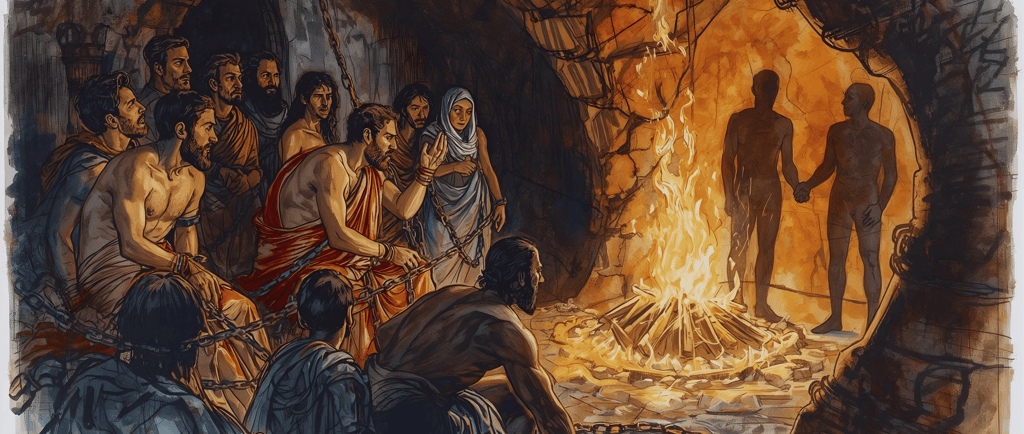
Plato captured this perfectly in his allegory of the cave: Prisoners chained underground mistake shadows on the wall for reality, preferring the familiar and unthreatening over the harsh sunlight outside. But here's the overlooked bit, they don't just reject the truth; they attack the one trying to free them, seeing it as a threat to their community. That's Socrates' story, and it's the fate of modern truth-tellers like whistleblowers or journalists. Ever caught yourself dismissing a fact because it didn't align with your mates' views? What does that reveal about our psychology?
Echoes Everywhere: From Families to the Front Pages
This dynamic isn't confined to ancient history, it’s all around us. In families avoiding awkward truths, workplaces stifling feedback, communities denying injustices, and nations blaming outsiders for internal woes. Rational societies make irrational calls, intelligent people buy absurd ideas in groups, and civilisations collapse despite obvious red flags because groups punish honesty and reward deception.
Plato's Radical Fix: A New Kind of Elite?
Plato didn't just diagnose the issue, he proposed a bold solution that might raise eyebrows today. He argued society should be led not by the masses or popularity contests, but by “philosopher-kings" - leaders rigorously trained in intellect and morals, who prioritise truth over comfort and wisdom over validation.
It sounds elitist, like handing the keys to a select few. But Plato's point wasn't innate superiority; it's that seeking truth and making wise decisions require skills and discipline not everyone develops. We wouldn't let untrained people perform surgery or repair a gas leak on your boiler - why entrust society's big calls to the unqualified?
Of course, in our modern world, the harsh reality is that it's already the governing elite running the show, not the elected figures like Kier Starmer, but the unelected ones: the monetary architects, the billionaires pulling strings behind the scenes. But imagine a different breed of elite, one aligned with unshakeable morals, relentless truth-seeking, independence from manipulation, and a commitment to freedom and transparency. A system where incentives aren't warped by fiat funny money but built on verifiable, decentralised honesty. Very much aligned to the principles of Bitcoin.
Stepping Out of the Shadows: Your Next Move
Plato's insights warn us that overcoming this cycle means choosing truth, curiosity, and independent thought over collective comfort. In the UK context, from laws like the Online Safety Act to broader calls for transparency in society, it's about breaking free from illusions.
Ever nodded along to a group lie for peace? Ready to question more?